


- Duration: 01.03.2026 – 28. 02. 2029
- Head: prof. dr. Vanja Kokol
- Organizations:University ob Maribor, Faculty of mechanical engineering, Institute for Environmental Protection and Sensors, BETI Tekstilna industrija d.o.o.
- Funding: Aris
- SICRIS link: https://cris.cobiss.net/ecris/si/en/project/24418
- Project content:
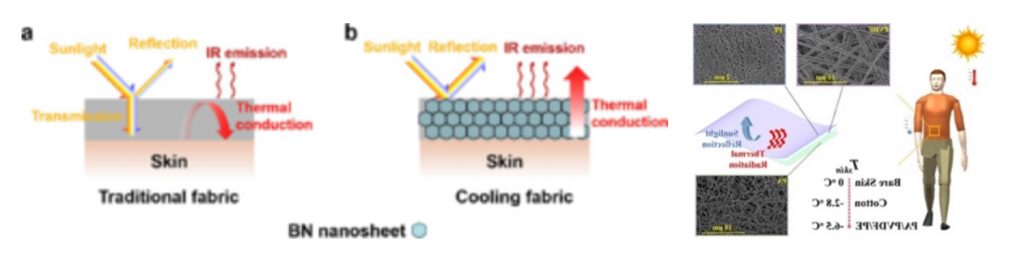
This project aims to develop novel platform technology for the production of thermally conductive and solar reflective PES and PA6 filament yarns by interface-integrated (low-cost, non-toxic, skin-safe) hexagonal-nanostructured boron nitride (hBN) of high thermal stability, superior in-plane thermal conductivity, large refractive index, and a wide band gap to effectively reflect or scatter sunlight and brings favorable passive radiative cooling properties. This will be achieved by (i) appropriate exfoliation and dispersing of different hBNs, and their integration in filament outer-surface structure using existing and incorporating more advanced technological processes, i.e. during (ii) draw-texturing phase, (iii) batch-exhaustion processing performed on pre-textured and/or differently-twisted filament yarns, (iv) spraying and near-infrared (NIR) radiation drying as economically and ecologically more acceptable alternative to conventional oven-curing. Plasma pre-treatment will be included to enhance the adhesion and orientation of hBNs. The fundamental thermal transport mechanisms will be evaluated by developing and validating a numerical model that will allow further optimization of the filament nanostructure design for their better performance. The influence of both yarn and fabric constructional parameters will be addressed to further increase cooling efficacy. A representative technology will be assessed by sustainability (LCA).
Specific phases and stage of realization:
- Determine how to chemically design and colloidally disperse hBNs to accelerate and control their deposition on plasma pretreated PES/PA6 filaments during processing to control their orientation, adhesion and interface integration.
- Systematically control the parameters of filaments (from draw-texturing and twisting to finishing) to understand the changes in thermal transport mechanisms in terms of filament morphology and crystallinity, as well as topography and surface chemistry.
- Evaluate the efficacy of filaments functionalization by co-using of US during bath-exhaustion or NIR radiation after spraying as faster, eco-friendly, and energy-less intensive processes.
- Utilize these data in developing and validating a numerical model by machine learning to predict the hBNs interface integration, and proposed design of filament yarns structure for optimal performance.
- Determine how to fabricate thermally conducting filament yarns and/or construct knitted fabric that would additionally or complementary to the finishing process contribute to the surface self-cooling activity under direct sunlight.
- Duration: 01.03.2026 – 28. 02. 2029
- Head: prof. dr. Miha Grilc
- Organizations: National Institute of Chemistry, Jožef Stefan Institute, University of Maribor, Faculty of Chemistry and Chemical Engineering, IOS, Institute for Environmental Protection and Sensors
- Funding: Aris
- SICRIS link: https://cris.cobiss.net/ecris/si/en/project/24390
- Project content:
Process electrification is a hot topic in the chemical industry nowadays. In order to mitigate fossil fuels, it is necessary to investigate the electrification of various chemical processes to explore different ways of energy supply. Biomass is a versatile and abundant natural material that can be converted to many useful value-added compounds used in different industrial branches, such as solvent and chemical manufacturing, fuel industry, pharmaceuticals, cosmetics and so on. A promising bio-based compound conversion electrification technique is magentic heating (MH). MH is an umbrella term which covers different heating mechanisms, whereas the most well-known ones are induction heating and magnetic hysteresis heating. The main idea of magnetic heating is direct local heat supply to the catalysts used in chemical processes, rather than using conventionally heated reactor systems, where the reaction mixture is heated from the outside inward (Figure 1). With the application of external alternating magnetic field (AMF), contactless heating of the reaction mixture is achieved, since the catalyst used in the process also acts as a heat source. Magnetic heating ensures rapid heating and cooling of the reaction mixture, while also keeping the reaction mixture cooler in comparison to the catalyst surface, keeping the reaction conditions milder. This property is extremely useful for bio-based compounds due to their sensitivity to elevated temperatures.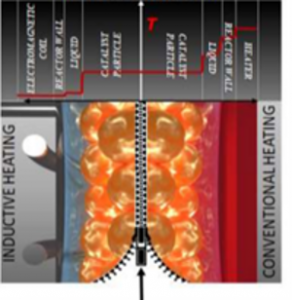
A schematic representation of the temperature profile in magnetically- and conventionally-heated reactor system.

- Duration: 01.03.2026 – 28. 02. 2029
- Head: prof. dr. Aleksandra Lobnik
- Organizations: IOS, Institute for Environmental Protection and Sensors, Jožef Stefan Institute, University of Maribor, Faculty of Chemistry and Chemical Engineering
- Funding: Aris / IOS d.o.o.
- SICRIS link: https://cris.cobiss.net/ecris/si/en/project/22678
- Project content:
The European industry faces mounting pressures to adopt alternative raw materials and alternative energy sources due to resource scarcity, rising costs, and the need for sustainable solutions. Textile waste presents a significant opportunity as a source of secondary raw materials (sRM) for the chemical and textile industries. The EU generates approximately 14.2 Mt of textile waste annually, yet only 1% is recycled, with the majority landfilled, incinerated, or reused as second-hand clothing. These practices lead to greenhouse gas emissions, environmental pollution, and a loss of valuable resources.
The TEXCYCLE project seeks to transform textile waste into sRM and alternative energy sources, addressing these challenges through advanced recycling technologies and digital innovation. By adopting a zero-waste philosophy and prioritizing material recycling over incineration, TEXCYCLE aligns with the EU Waste Framework Directive and promotes a circular economy. The project integrates enzymatic and chemical processes to recycle natural and synthetic fibers and their blends, enhancing carbon circularity and reducing dependence on petroleum-based resources.
The TEXCYCLE objectives are structured across specific work packages (WPs) to ensure a systematic and comprehensive approach. WP1 focuses on the development of novel enzymes, proteins, and microorganisms, along with the study of metabolomics to uncover innovative methods for recycling synthetic and natural textile wastes, and their blends. WP2 and WP3 are dedicated to designing enzymatic/chemical/and physical processes to optimize the pre-tretamen as well recycling of textile waste. These WPs collectively aim to achieve the best possible recycling outputs and provide a solid foundation for the TEXCYCLE technical innovation. Validation of the developed recycling processes is undertaken in WP4, where the outputs from WP3 are thoroughly assessed to confirm their effectiveness and efficiency. WP5 ensures a closed-loop approach by addressing wastewater and solid waste generated across WP1-WP4, ensuring that the project minimizes its environmental footprint and enhances its sustainability. The horizontal work packages WP6 and WP7 provide support to work packages WP1-5, with extensive characterization and circular infrastructure, including data management, life cycle and cost assessment (LCA/LCC), digital passport, and design for safety and sustainability (SSbD). With a holistic, multidimensional approach to recycling synthetic and natural textile waste, TEXCYCLE leverages enzymatic and chemical technologies to reintegrate carbon resources into production cycles and promote carbon circularity. These innovative technologies not only transform waste into valuable chemical feedstocks and energy, thereby reducing pressure on existing petroleum-derived resources, but also enable precise tracking of carbon content to ensure efficient recirculation, significantly contributing to climate change mitigation and improved resource efficiency.
- Duration: 01. 01. 2025 – 31-12 2027
- Head: prof. dr. Urban Bren
- Organizations: IOS, d.o.o., JSI, UM FKKT
- Funding: Aris / IOS d.o.o.
- SICRIS link: https://cris.cobiss.net/ecris/si/en/project/22678
- Project content:
With the signing of the UNEP Minamata Convention in 2013 and its ratification in 2017, the World’s governments have accepted that mercury is toxic and of global relevance. In a natural process of biomethylation, methylmercury is generated, which tends to accumulate in the biosphere and undergo biomagnification reaching concentrations up to 10 million times higher in seafood than in corresponding aquatic environments. The intake of methylmercury through contaminated fish represents the causative agent of the Minamata disease – a chronic neurological disorder. This health threat is unfortunately also of extreme relevance for Slovenia as one of the most mercury-contaminated places in Europe, the legacy of the Idrija Mercury Mine, the second largest in the World, which was operational for five hundred years.
Traditional methodologies for methylmercury determination are time-consuming, demand expensive experimental equipment, and necessitate skilled personnel for accurate execution. Consequently, these analyses remain confined to a relatively small number of specialized laboratories, limiting the scalability and widespread applicability of such approaches. In the proposed applied research project we will reduce these limitations by developing an effective, portable, low-cost, real-time electrochemical biosensor for methylmercury detection in seafood. Currently, no such electrochemical biosensor is available either in academic or commercial settings. Bacterial enzymes MerB – an organomercurial lyase – and MerA – a mercuric ion reductase – as well as their complex will serve as potent biorecognition elements since bacteria have undergone a billion years of gene evolution trying to detoxify methylmercury to mitigate its toxicity with the help of mer operon. The two enzymes will be expressed in chemically competent E. coli model organisms by recombinant technologies and purified by Dynabeads His-Tag Isolation and Pulldown magnetic beads. Stainless steel will be applied as the working electrode and covered by a thin layer of gold using sputtering or electrodeposition to further increase its electric conductivity. Nitrilotriacetic acid (NTA)-thiol monolayer will self-assemble on the gold surface and complexate nickel ions, which will in turn bind and thereby immobilize the His-tagged MerA or MerB enzymes. A three-electrode biosensor will then be constructed and subjected either to electrochemical impedance spectroscopy or voltammetry. The methylmercury NIST (National Institute of Standards and Technology) standard will be subsequently applied to stringently determine the corresponding linearity range as well as the limits of detection and quantification of the developed biosensor. Possible seafood matrix interferences will be also carefully evaluated and a suitable pretreatment protocol established to eliminate them.
The structure of the complex between MerB and MerA enzymes represents yet another important scientific contribution of the proposed research project because it has not yet been determined by any experimental or computational means. The presence of this complex was, however, experimentally confirmed by enzyme buffering tests, which have shown that the observed reduction rates exceed the values anticipated through Hg2+ free diffusion alone indicating the existence of the substrate channeling mechanism. In the current project proposal we will, therefore, for the first time discern the structure of the MerB-MerA enzymatic complex using advanced protein-protein docking imposing also the geometrical constraints required for an efficient substrate channeling. Moreover, both MerB and the complex will also undergo extensive molecular dynamics simulations to reveal their conformational changes upon methylmercury binding, which dictate the response of an electrochemical impedimetric biosensor. These will be coupled with empirical free-energy calculations set up to validate the developed computational platform.

- Duration: 01. 01. 2025 – 31-12 2027
- Head: prof. dr. Milena Horvat
- Organizations:
IOS d.o.o., IJS, UL MF, UL FF, ZC SAZU, Alpacem Cement d.d., AEROSOL d.o.o., MEIS d.o.o., MPŠ
- Funding: Aris
- IJS link: https://tinyurl.com/4dbuuvk8
- SICRIS link: https://cris.cobiss.net/ecris/si/sl/project/22975
- Project web site link: https://multipart.si/en/
- Partners: IOS, Inštitut za okoljevarstvo in senzorje, d.o.o. (Slovenija);
- Project value: 3.500.045 €
- Duration of the project: 24M; 01. 04. 2023 – 30. 09. 2025
- Description of the project:
OpenLOOP is delivering a novel chemical recycling technology that:- Can be used to degrade any mixture and blend of PET (polyethylene terephthalate) plastic and CELLULOSE waste.
- As a final output yields high-value feedstock: 5-HMF (5-hydroxymethylfurfural), LA (Levulinic acid), furfural, and rTA (recycled terephthalic acid).
- Is environmentally friendly using and clean and can be successfully implemented in industrial environment.
The OpenLOOP technology consists of several IOS’s proprietary processing steps involving chemical and enzymatic hydrolysis to separate PET and CELLULOSE, neutral hydrolysis to depolymerise PET, rTA purification, chemical hydrolyses amd purification to to extract 5-HMF/furfural/LA.
OpenLOOP will mature the technology, integrate it into industrial environment – IOS’s DEMO plant, automate procedures to make them safe and simple to operate, validate it, engineer process steps to deliver optimal productivity and prepare it for market entry.
HE JU CBU – MIX MATTERS – https://mixmatters.eu/
Description of the project: In accordance with the recycling objectives outlined in the Waste Framework Directive, which aims to reduce the proportion of municipal bio-waste sent to landfill to 10% by 2035, this call emphasizes the adoption of separation and conversion technologies for mixed bio-waste streams. Contributing to this, MixMatters introduces its Integrated System, a pioneering and adaptable solution for effectively valorising mixed biological waste. The outcome of this process will provide six bio-based outputs with significant added value.
The Integrated system consists of three key components. The mobile and modular Separation Unit is responsible for sorting and separating the feedstock, concentrating the recovered streams of mixed agri-food waste. With the integration of robotics and AI, it can process various waste types on-site, eliminating the need for complex transportation. The Valorisation Hub, a fixed biorefinery, utilizes advanced technologies to treat the separated streams, generating six valuable outputs. Following a cascading use approach, the entire stream is efficiently utilized. The system is integrated through an advanced Decision Support system, optimising the configuration and logistics for maximum efficiency. It can adapt to regional contexts and offers processing variability to serve diverse agri-food sectors effectively.
During the project, MixMatters will conduct three comprehensive demonstrations in Spain, specifically locating two of them in Valencia and one in the Almería region. Our primary aim throughout these demonstrations is to effectively separate and valorise a total of 48 tonnes of mixed biological waste. By implementing our innovative solution, we anticipate that this waste management strategy will result in a remarkable outcome, leading to the prevention of 21 tonnes of annual CO2 emissions during the demonstration phase. This significant reduction in carbon dioxide emissions showcases the environmental benefits and sustainable impact that can be achieved through our waste valorisation efforts.
Project Founding: This project is supported by the Circular Bio-based Europe Joint Undertaking and its members under grant agreement No 101112409.
Duration: 48M (1.6.2023- 31.5.2027)
Role of IOS Ltd.: Project partner

HE – PESCO-UP – https://www.pesco-up.eu/
Description of the project: Europe has an extensive textile waste problem – annually 7 –7.5 million tons of textile waste is generated, but only about 30 – 35 % of the generated waste is collected separately and less than 1% is recycled into new clothing. Collection of textile waste will become mandatory in EU member states by 2025. Most of the textile are cotton, polyester, or their blends. Considerable amounts of CO/PES blends are disposed every year due to the technical challenge and/or economic viability of recycling. The objective of PESCO-UP is to develop a sustainable and economically and technologically viable process of the mixed CO/PES textile waste to be upcycled into cotton originated and polyester products. The processes should enable for production of new products without quality restriction and of products with identical properties and performances as those produced using primary resources. The main tools to achieve this are the development of automated identification and sorting methods for textiles, Digital Product Passport with a marketplace-style dataspace for sharing data describing material streams to support matching of supply and demand of textile materials, and the process development of purification, separation technologies as well as the technologies that utilize the separated cotton and PES fractions for the valuable products. PESCOUP will ensure that sustainable fiber-to-fiber recycling becomes a reality in Europe. This will turn a societal waste problem into a business opportunity for European SMEs and bring the textile industry back to Europe. At the same time dependency on oil and cotton based raw materials will decrease, which will mean reduction in CO2 emission and reduced water consumption. The use of developed digital methods and digital product passport can be widened in other industrial sectors to solve their recycling and sustainability issues.
Project Founding: The project is partially co-financed by the European Union under grant agreement No 101138367.
Duration: 48M (1.1.2024 – 31.12.2027)
Role of IOS Ltd.: Project partner

- Duration: 01. 01. 2022 – 31-12 2027
- Head: prof. dr. Aleksandra Lobnik
- Organizations: Inštitut “Jožef Stefan”, Univerza v Ljubljani – Biotehniška fakuletata, Univerza v Mariboru – Fakulteta za strojništvo, Univerza v Mariboru – Fakulteta za elektrotehniko, računalništvo in information, IOS – Inštitut za okoljevarstvo in seznrje, proizvodnja, trgovina in storitve d.o.o.
- SICRIS link: https://cris.cobiss.net/ecris/si/en/project/18938
- Leaflet: Design of novel (nano)material properties & Applications
- Duration: 01. 07. 2022 – 31.12.2027
- Head: prof. dr. Urban Bren
- Organization: IOS Institute of Environmental Protection and Sensors Ltd
- SICRIS link: https://cris.cobiss.net/ecris/si/en/project/18938
- Leaflet: Optical Chemical/Bio Sensor Systems (OPTISENS)
- Duration: 01. 10. 2022 – 30. 09. 2024
- Head: dr. Ajra Hadela
- Organization: IOS Institute of Environmental Protection and Sensors Ltd
- Grant amount: 137.020,00€
- SICRIS link: https://cris.cobiss.net/ecris/si/en/project/20078
- Leaflet: Development of multifunctional nanocomposite fibrous electrodes for electro-oxidation filtration
- Duration: 01. 10. 2022 – 30. 09. 2025
- Head: prof. dr. Mojca Škrget
- SICRIS link: https://cris.cobiss.net/ecris/si/en/project/20247
- Link of the project: https://www.fkkt.um.si/laboratoriji/laboratorij-za-separacijske-procese-in-produktno-tehniko-primarni-zavihki/raziskovalna-dejavnost/

- Projekt: Global Mercury Observation Training Network In Support to the Minamata Convention (GMOS Train – ITN EU)
Opis projekta:
The Marie Skłodowska-Curie Action “Global Mercury Observation and Training Network in Support to the Minamata Convention” is an international research project, coordinated by Prof. Milena Horvat from the Jožef Stefan Institute (JSI) and is financed under the funding line “excellent science” of the Horizon 2020 research and innovation programme of the European Commission. In this very competitive scheme the project received total score 100%. It includes 11 European project partners and participates with eminent research institutions, such as Harvard University and MIT, and other organisations, such as UN Environment, JRC Ispra and eminent NGOs.
The overall objectives of the GMOS-Train network are:
(1) to provide urgently needed training in Hg science within the context of the UNEP Minamata Convention, and
(2) to fill key knowledge gaps in biogeochemical Hg cycling linking anthropogenic emissions and Hg in marine food webs.
ESRs will be trained through a structured and comprehensive programme and will not only learn the theory but will gain first-hand lab experience. The partners engaged in the project will work closely together, with each of the partners supervising at least one research project. All ESRs will spend time not only at the hosting institution but also in one of the other partner universities/research centers/regulatory agencies/companies involved in GMOS Train project throughout Europe. Being trained in highly relevant research topics will enhance researchers career prospective and employability. The GMOS-Train aims to recruit outstanding and highly motivated ESRs to meet the ambitious goals of the project.
All applications must be submitted by means of on-line application on the official GMOS-Train project website. Deadline for application is April 30th 2020.
Please find details about the application process and modalities at www.gmos-train.eu.
COORDINATING ORGANISATION: Jožef Stefan Institute on behalf of the GMOS-Train consortium
RESEARCH FIELD: Environment and Health Science
RESEARCH PROFILE: Early Stage Researcher (ESR)
APPLICATION DEADLINE: 30 April 2020 23:00 – CET (Europe/Brussels)
SELECTION COMPLETED: by 30 June 2020
ESR SELECTED AND RECRUITED: by the deadline 30 September 2020
EU RESEARCH FRAMEWORK PROGRAMME: H2020 / Marie Skłodowska-Curie Actions
MARIE CURIE GRANT AGREEMENT NUMBER: 860497
WORK LOCATION: Multiple locations
(secondments to project partners)TYPE OF CONTRACT: Temporary
JOB STATUS: Full-time, 36 Months
INDICATIVE WORKING HOURS PER WEEK: 40


- Partners: Surovina d.o.o. (Lead partner; J. Fišer); IOS, d.o.o. (Partner; A. Lobnik); MESSER SLOVENIJA d.o.o.; MIKRO+POLO, d.o.o.; OMEGA d.o.o.; ROTO d.o.o.; SNAGA d.o.o.; TEKSTINA d.o.o.: EKTC Maribor, so.p.
-
Description: The POLY CIRCULARITY project aims to develop innovative technologies for chemical and biochemical decomposition of packaging waste into high quality secondary raw materials with added value (gases, chemicals, oils / fuels, etc.) also suitable for incorporation into new products such as biopolymers. The focus is on packaging waste of natural origin, i.e. from cellulose/ lignocellulose and synthetic/ plastic packaging (PET, PA, PP, PE, XPE, etc.). The main goal of the project is to establish new advanced circular processes and circular business models for the recycling of synthetic/ natural polymer packaging waste. The result of the project will be reflected in high-quality secondary raw materials for use in new products intended for the domestic and global market.
»The operation is partly financed by RS and EU funds (European Regional Development Fund).« (http://www.eu-skladi.si/?set_language=en)
Grant amount: 2.800.486,22 EUR.
Duration: 1.9.2019 – 31.5.2022

- Partners: IOS, Institute for Environmental Protection and Sensors Ltd. (Slovenia); ROTO-GRAD d.o.o. (Croatia)
Short description:
HMRecycle project will introduce a heavy metal (HM) recycling system for wastewater treatment or more precisely, the novel membrane biological reactor (MBR) with innovative nano pre-treatment cartridge that contains functionalized nanomaterials (FNMs) as adsorbents for heavy metals. Adsorbents can later be reused and heavy metals recycled. With the optimization of functionalized nanomaterials (FNMs) and the innovative HMRecycling MBR system, we will be able to clean and reuse not only municipal, but also leachate/industrial wastewaters, where existing MBR treatment plants are not effective. HMRecycling system represents a complete market novelty, as it has wider applicability and introduces a new technological approach to the recycling of heavy metals from wastewaters.The novel HMRecycling MBR system will reprezent a novel, up to 40% more efficient treatment system in comparison to the classical MBR, as well as an easy handling solution for leachate/industrial wastewater treatment and reuse, for extraction of secondary raw materials from such wastewaters, for reduction of operating costs and reduction of negative environmental impacts.
Budget: 0,873 mio. €.
Duration: 01.09.2019 – 31.08.2022.
Role of IOS Ltd.: Project leader

- Project »COMPETENCY CENTER OF THE NETWORK FOR THE TRANSITION TO THE CIRCULAR ECONOMY; KOC – CIRCULAR ECONOMY ”within the framework of the Public Call for Proposals for co-financing the establishment and operation of competence centers for human resources development in the period 2019-2022.
- Short description of the project:
The purpose of the project is to train and improve priority competences, productivity, creativity and innovation of employees and to strengthen the competitiveness of the Slovenian economy through informal training.
The aim of the project is to improve the key competences of the employees and thus increase their flexibility, employability and efficiency; raising the awareness of employees and employers of the necessity of a lifelong approach to training; enhancing networking, business networking and the transfer of good HR practices; enhancing the competitiveness and innovation of the Slovenian economy; promotion of the S4 Scopes and horizontal ICT priority area.
Project leaders: GZDBK in ŠGZ
Name of beneficiary: IOS, d.o.o. - Short description of operation:
Within the Project “COMPETENCE CENTER OF THE NETWORK FOR THE TRANSITION TO A CIRCULAR ECONOMY; KOC – CIRCULAR ECONOMY « is planned 30 inclusions or 7 – 8 inclusions per year in training for priority competencies in various fields.
Contract value of operation: 15.000 €. - Duration: 30M (Sept. 2019 – from the date of decision document – 31.may 2022)
- Contact person: Prof. dr. Aleksandra LobnikThe operation is partially funded by EU / ESF (European Social Fund), Public Scholarship, Development, Disability and Maintenance Fund of the Republic of Slovenia and MDDSZ.
